Beyond Compliance: How a Well-Built PMS Database Cuts Unplanned Downtime
Published by Jakarta Maritime Consultants
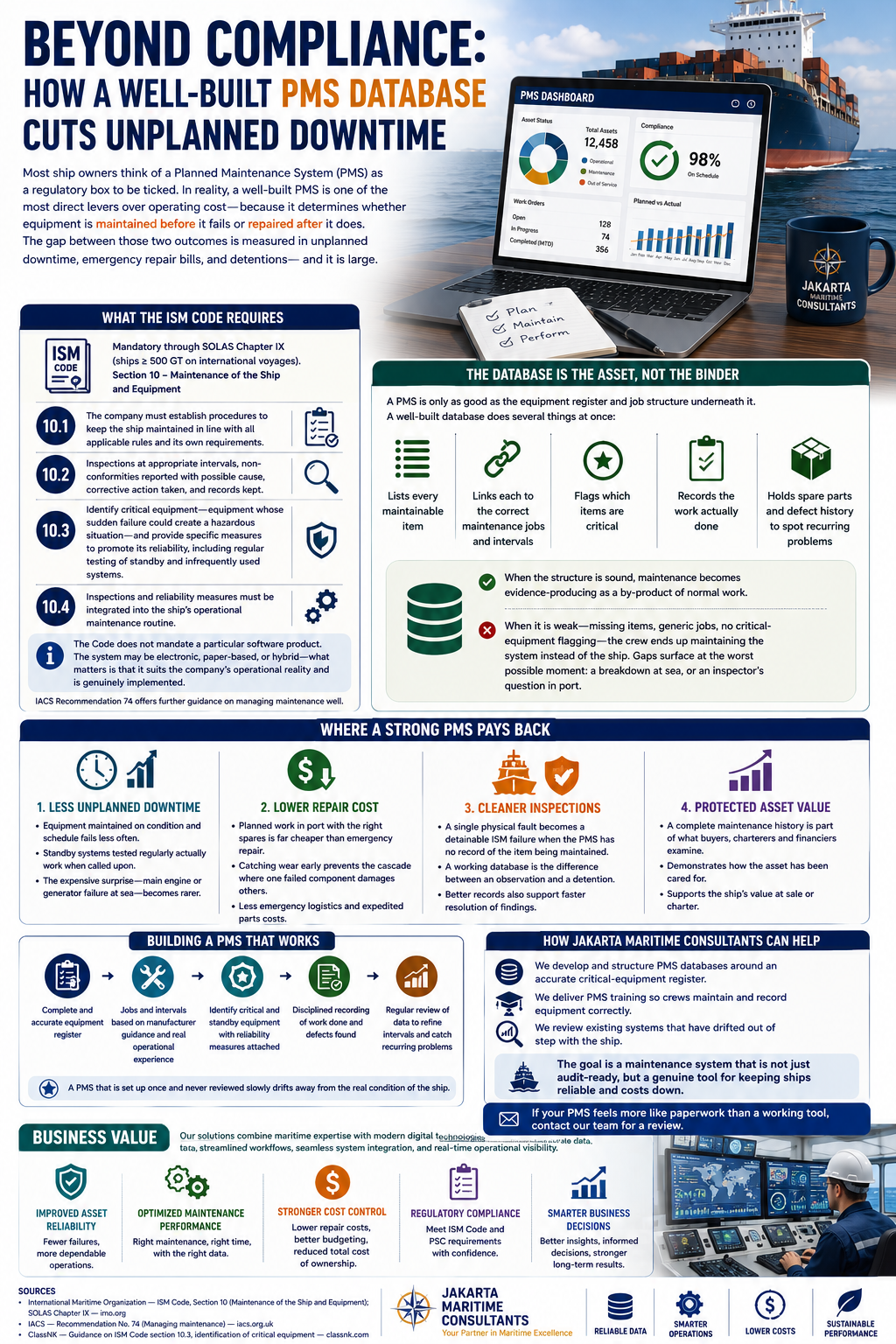
Most ship owners think of a Planned Maintenance System (PMS) as something the auditors ask about — a regulatory box to be ticked. That view sells it short. A well-built PMS is one of the most direct levers an owner has over operating cost, because it determines whether equipment is maintained before it fails or repaired after it does. The gap between those two outcomes is measured in unplanned downtime, emergency repair bills, and detentions — and it is large.
This article explains what the rules actually require, why the database itself — not the paperwork around it — is where the value sits, and how a strong PMS pays back across the whole operation.
What the ISM Code requires
The legal foundation is the ISM Code, made mandatory through SOLAS Chapter IX and applying to cargo ships of 500 GT and above on international voyages. Section 10, “Maintenance of the Ship and Equipment,” sets out the obligation in four parts:
- 10.1 — the company must establish procedures to keep the ship maintained in line with all applicable rules and its own requirements.
- 10.2 — inspections must be held at appropriate intervals, non-conformities reported with their possible cause, corrective action taken, and records kept.
- 10.3 — the company must identify critical equipment — equipment whose sudden failure could create a hazardous situation — and provide specific measures to promote its reliability, including regular testing of standby and infrequently used systems.
- 10.4 — those inspections and reliability measures must be integrated into the ship’s operational maintenance routine.
Importantly, the Code does not mandate a particular software product. A maintenance system may be electronic, paper-based, or hybrid — what matters is that it suits the company’s operational reality and is genuinely implemented. IACS Recommendation 74 offers further guidance on managing maintenance well.
The database is the asset, not the binder
The phrase most owners underestimate in Section 10.3 is “identify critical equipment.” A PMS is only as good as the equipment register and job structure underneath it. A well-built database does several things at once: it lists every maintainable item, links each to the correct maintenance jobs and intervals, flags which items are critical, records the work actually done, and holds the spare-parts and defect history that lets you spot recurring problems.
When that structure is sound, maintenance becomes evidence-producing as a by-product of normal work. When it is weak — missing items, generic jobs, no critical-equipment flagging — the crew ends up maintaining the system instead of the ship, and the gaps surface at the worst possible moment: a breakdown at sea, or an inspector’s question in port.
Where a strong PMS pays back
The return on a well-built PMS shows up in four places that every owner cares about:
- Less unplanned downtime. Equipment maintained on condition and schedule fails less often. Standby systems tested regularly actually work when called upon. The expensive surprise — a main-engine or generator failure at sea — becomes rarer.
- Lower repair cost. Planned work done in port with the right spares is far cheaper than emergency repair with parts flown to a convenient port. Catching wear early also prevents the cascade where one failed component damages others.
- Cleaner inspections. As noted in our Port State Control guide, a single physical fault becomes a detainable ISM failure when the PMS has no record of the item being maintained. A working database is the difference between an observation and a detention.
- Protected asset value. A complete maintenance history is part of what a buyer, charterer, or financier examines. It demonstrates how the asset has been cared for, and it supports the ship’s value at sale or charter.
Building a PMS that works
A maintenance system delivers these benefits only when it is built and used correctly. In practice that means a complete and accurate equipment register; jobs and intervals based on manufacturer guidance and real operational experience, not generic templates; clear identification of critical and standby equipment with reliability measures attached; disciplined recording of work done and defects found; and periodic review of the data to refine intervals and catch recurring problems. A PMS that is set up once and never reviewed slowly drifts away from the real condition of the ship.
How Jakarta Maritime Consultants can help
Building and maintaining the database that underpins all of this is core to our work. We develop and structure PMS databases around an accurate critical-equipment register, deliver PMS training so crews maintain and record equipment correctly, and review existing systems that have drifted out of step with the ship. The goal is a maintenance system that is not just audit-ready, but a genuine tool for keeping ships reliable and costs down.
If your PMS feels more like paperwork than a working tool, contact our team for a review.
Sources
- International Maritime Organization — ISM Code, Section 10 (Maintenance of the Ship and Equipment); SOLAS Chapter IX — imo.org
- IACS — Recommendation No. 74 (Managing maintenance) — iacs.org.uk
- ClassNK — Guidance on ISM Code section 10.3, identification of critical equipment — classnk.com
This article summarises widely published guidance on the ISM Code and is not a substitute for the full text of the Code or the specific requirements of a vessel’s flag State and classification society.