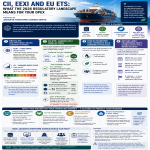
CII, EEXI and EU ETS: What the 2026 Regulatory Landscape Means
for Your OPEX
Published by Jakarta Maritime Consultants
For ship
owners, 2026 marks a turning point in how environmental regulation hits the
bottom line. Rules that were once described as “coming soon” are now live and
carrying real costs. The European Union’s carbon market for shipping has
reached full strength, the IMO’s efficiency ratings continue to tighten, and a
global pricing system is being negotiated that could reshape fuel economics for
the entire world fleet.
The acronyms
can feel overwhelming — EEXI, CII, EU ETS, FuelEU, the IMO Net-Zero Framework —
so this article explains what each one actually does, what it costs, and what
an owner should be doing about it. The common thread is simple: compliance is
now an operating-expense item, and the owners who plan for it will protect
their margins far better than those who treat each rule as a surprise.
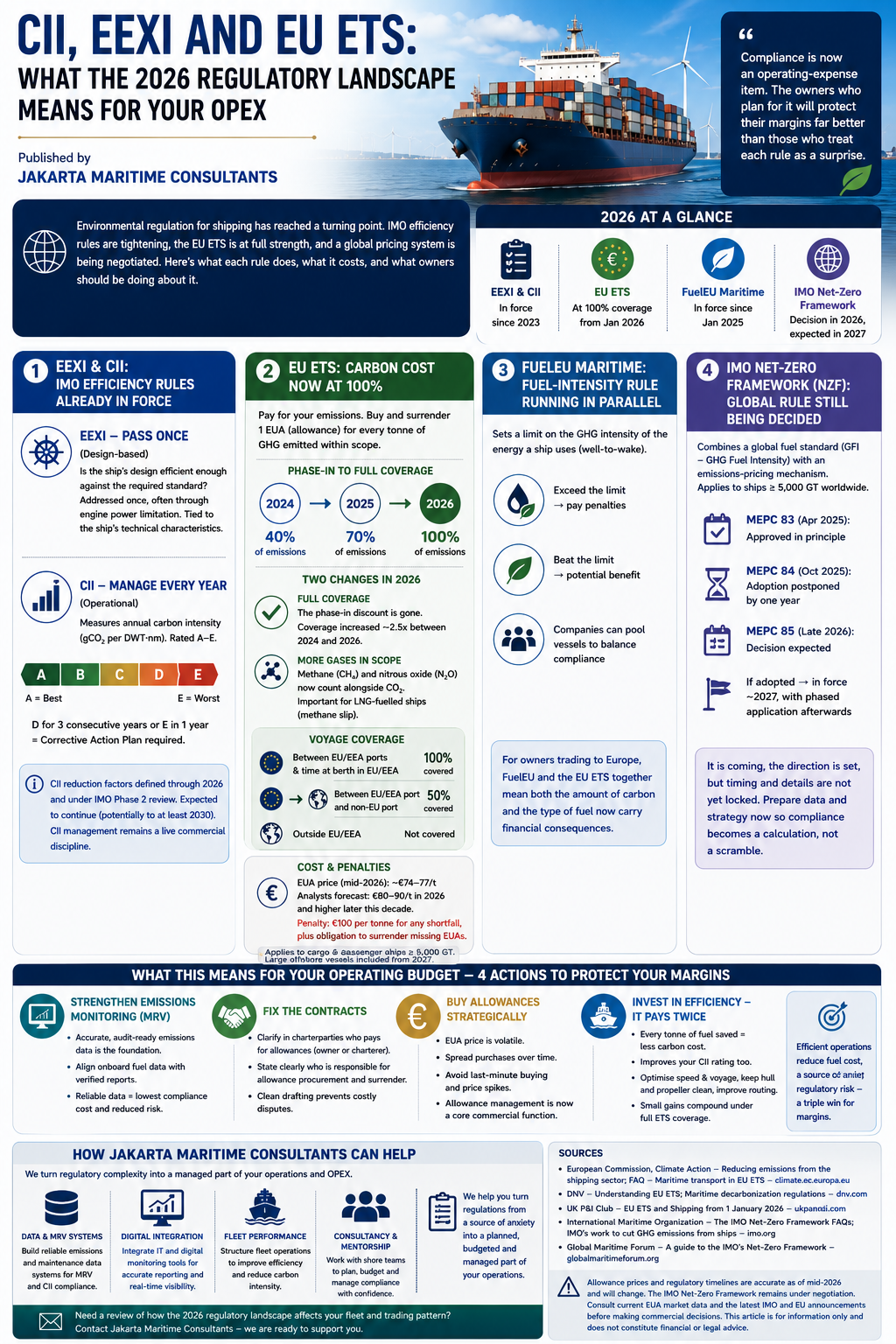
EEXI and CII: the IMO efficiency rules already in force
Since 1 January
2023, two IMO measures have applied to the existing fleet.
The EEXI
(Energy Efficiency Existing Ship Index) is a one-time, design-based measure.
It asks a straightforward question: is your ship’s design efficient enough
against a required standard? Most owners addressed EEXI when it came into
force, often through engine power limitation. It is a “pass once” requirement
tied to the ship’s technical characteristics.
The CII
(Carbon Intensity Indicator) is the one that demands ongoing attention. CII
is an operational measure: it looks at how much carbon a ship emits relative to
the cargo it carries and the distance it sails over a full year. Each ship
receives an annual rating from A to E, where A is best. A vessel rated D for
three consecutive years, or E in a single year, must produce a corrective
action plan. The required intensity tightens over time, so a ship that scores a
C today can slip to a D in a later year without changing anything — simply
because the bar has moved.
A practical
point worth knowing: the CII reduction factors have so far been defined only
through 2026, and the measure is under a Phase 2 review at the IMO. Current
indications are that CII will continue in some form alongside the newer global
framework, potentially to at least 2030. For owners, that means CII management
— through speed and voyage optimisation, hull and propeller cleaning, and
operational efficiency — remains a live commercial discipline, not a box
already ticked.
EU ETS: the carbon cost that is now at 100%
The biggest
immediate change in 2026 is the EU Emissions Trading System (ETS) reaching full
strength for shipping. Under the ETS, a shipping company must buy and surrender
one tradable allowance (an EUA) for every tonne of greenhouse gas it emits
within scope. In effect, carbon now has a direct price on the ship’s books.
The system
phased in deliberately: companies surrendered allowances for 40% of emissions
reported in 2024, 70% of 2025 emissions, and from 1 January 2026, 100% of
emissions are covered. Two changes landed together in 2026, and both raise
costs:
•
Full coverage. The discount of the phase-in
years is gone. Coverage increased roughly 2.5 times between 2024 and 2026,
before any change in the allowance price itself.
•
More gases in scope. From 2026, methane (CH₄)
and nitrous oxide (N₂O) count alongside CO₂. This matters in particular for
LNG-fuelled ships, where “methane slip” — unburned methane passing through the
engine — can now add meaningfully to the allowance bill.
Which
voyages are covered? The geography is the key to understanding your
exposure. Emissions on voyages between two EU/EEA ports are covered at 100%, as
is time spent at berth in an EU/EEA port. Voyages between an EU/EEA port and a
non-EU port are covered at 50%. Outside that, there is no obligation. The
system applies to cargo and passenger ships of 5,000 GT and above, with large
offshore vessels brought in from 2027.
What does it
cost? The allowance price moves with the market by design. Through the
first part of 2026 the EUA price traded in roughly the €74–77 per tonne range,
with analysts forecasting averages around €80–90 for the year and higher later
in the decade. To make this concrete: a large container ship can incur several
hundred thousand euros in ETS cost on a single long-haul voyage into Europe.
And the penalty for coming up short is severe — €100 per tonne for any
shortfall, and the company still has to find and surrender the missing
allowances afterwards.
FuelEU Maritime: the fuel-intensity rule running in parallel
Often
overlooked next to the ETS, FuelEU Maritime has been in force since 1 January
2025. Rather than pricing carbon directly, it sets a limit on the greenhouse-gas
intensity of the energy a ship uses, measured on a well-to-wake basis (counting
emissions from fuel production through to combustion). Ships that exceed the
limit pay penalties; ships that beat it can benefit, and companies can pool
vessels to balance compliance across a fleet. For owners trading to Europe,
FuelEU and the ETS together mean that both the amount of carbon and the type of
fuel now carry financial consequences.
The IMO Net-Zero Framework: the global rule still being decided
Looking beyond Europe,
the IMO is working toward the first global, binding carbon-pricing system for
shipping — the Net-Zero Framework (NZF). It combines a global fuel standard,
based on a GHG Fuel Intensity (GFI) metric, with an emissions-pricing
mechanism, and it would apply to ships of 5,000 GT and above worldwide.
Owners should
understand its status clearly, because it remains uncertain. The framework was
approved in principle at MEPC 83 in April 2025. Formal adoption was expected in
October 2025 but was postponed by one year amid significant political
disagreement; the IMO is due to reconvene in late 2026 (MEPC 85). If adopted
then, the rules would be expected to enter into force around 2027 under the
usual procedure, with application phased in afterwards. In short: it is coming,
the direction is set, but the timing and final detail are not yet locked. The
sensible response is to prepare the data and the strategy now, so that
compliance becomes a calculation rather than a scramble if and when the
framework takes effect.
What this means for your operating budget
Put together,
these rules turn carbon and fuel quality into permanent OPEX lines that vary
with your trading pattern, your fuel choices, and a market price you do not
control. The owners who manage this well tend to do the same four things:
1.
Strengthen emissions monitoring (MRV). Accurate,
audit-ready emissions data is the foundation of every one of these rules. If
your onboard fuel data and your verified reports do not align, you risk both
penalties and over-purchasing allowances. Reliable data is the cheapest form of
compliance.
2.
Fix the contracts. Under a charter, who pays for
the allowances — owner or charterer? Ambiguity here is now a direct financial
risk. Charterparties should state clearly who is responsible for allowance
procurement and surrender. Clean drafting prevents expensive disputes.
3.
Buy allowances strategically. Because the EUA
price is volatile, spreading purchases over time and avoiding last-minute
buying can protect against price spikes. Allowance management is becoming a
core commercial function, not an afterthought.
4.
Invest in efficiency — it pays twice. Every
tonne of fuel saved is a tonne of carbon you do not have to pay for, and it
improves your CII rating at the same time. Speed and voyage optimisation, hull
and propeller performance management, and better weather routing all reduce
both fuel cost and regulatory exposure. Even small efficiency gains compound
under full ETS coverage.
How Jakarta Maritime Consultants can help
Navigating this
landscape is, at its core, an asset-management and data challenge — exactly
where our work is focused. We help owners build the reliable emissions and
maintenance data systems that underpin MRV and CII compliance, integrate IT and
digital monitoring tools for accurate reporting, and structure fleet operations
to improve efficiency and carbon intensity. Through our fleet management
consultancy and mentorship, we help shore teams turn these regulations from a
source of anxiety into a planned, budgeted, and managed part of operations.
If you would
like a review of how the 2026 regulatory landscape affects your specific fleet
and trading pattern, contact our team.
Sources
•
European Commission, Climate Action — Reducing emissions from
the shipping sector; FAQ – Maritime transport in EU ETS — climate.ec.europa.eu
•
DNV — Understanding EU ETS; Maritime decarbonization regulations
— dnv.com