Preparing for Port State Control: A Practical Guide to Avoiding
Detentions
Published by Jakarta Maritime Consultants
A Port State
Control (PSC) detention is one of the most expensive events that can happen to
a vessel that is otherwise trading normally. The ship is held in port until
deficiencies are corrected, the charterer may put the vessel off-hire, and the
detention is recorded against the ship, its flag, its classification society,
and its manager — raising the risk of being targeted again at the next port.
For a ship owner, a single detention can erase the margin on an entire voyage.
The encouraging
news is that detentions are largely predictable and preventable. Year after
year, the same handful of problems account for most of the findings. Once you
understand what inspectors look for and build your daily routines around it, a
clean inspection becomes the normal outcome rather than a lucky one.
What the 2024 numbers tell us
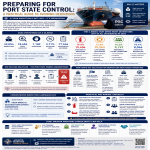
The Tokyo MOU —
the Port State Control regime covering the Asia-Pacific region, which is
directly relevant to vessels trading across ASEAN — published clear data for
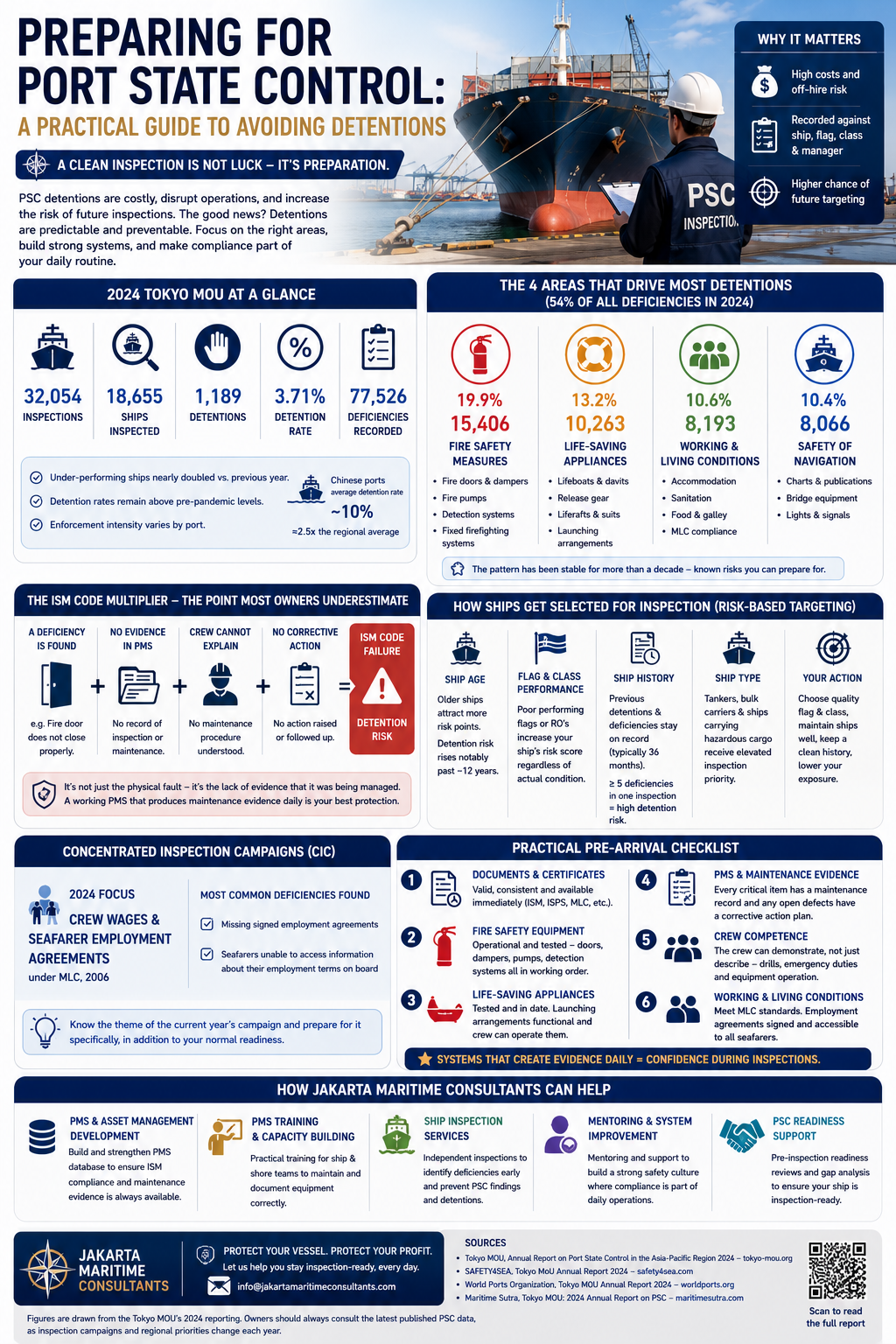
2024. Member authorities carried out 32,054 inspections involving 18,655
individual ships across 107 flags. From those, 1,189 ships were detained, a
detention rate of 3.71%, and a total of 77,526 deficiencies were recorded.
Two findings
deserve an owner’s attention. First, the number of “under-performing” ships in
the region nearly doubled compared with the previous year, which the Tokyo MOU
reads as a sign that the average condition of ships in the region is getting
worse — not better. Second, detention rates remain above pre-pandemic levels.
In other words, enforcement pressure is not easing, and the gap between
well-run fleets and neglected ones is widening.
It is also
worth knowing that enforcement intensity varies by port. In Chinese ports, for
example, the average detention rate sits at roughly 10% — about two and a half
times the regional average — because of stricter enforcement and the volume of
older tonnage calling there. A vessel that passes easily in one port may face a
far more demanding inspection in another.
The four areas that drive most detentions
Across the
Tokyo MOU in 2024, four deficiency categories together made up about 54% of all
recorded deficiencies:
•
Fire safety measures — the single largest
category, with 15,406 deficiencies. Inspectors check fire doors, dampers, fire
pumps, detection systems, and that fixed firefighting systems are operational
and properly maintained.
•
Life-saving appliances — 10,263 deficiencies.
Lifeboats and davits, release gear, liferafts, immersion suits, and launching
arrangements.
•
Working and living conditions — 8,193
deficiencies, an area that rose sharply in 2024 (see the crew-welfare focus
below).
•
Safety of navigation — 8,066 deficiencies.
Charts and publications, bridge equipment, lights and signals.
The pattern has
been stable for more than a decade, which is exactly why it is good news for
owners: these are known risks you can prepare for.
The ISM Code multiplier — the point most owners underestimate
A single
visible deficiency rarely causes a detention on its own. The real danger is what
happens next. Suppose a PSC officer finds a fire door that does not close
properly. That is a fire-safety deficiency. But if the Planned Maintenance
System (PMS) has no record of that fire door ever being inspected, and the crew
cannot explain the maintenance procedure, and no corrective action was raised —
that single fire door now becomes an ISM Code failure, which is detainable.
This is why a
working Safety Management System matters so much. The difference between a
minor observation and a detention is often not the physical fault itself, but
whether your systems can show that the fault was being managed. A PMS that
produces maintenance evidence as a natural by-product of daily work is your
best protection. A binder that is only opened before an inspection is not.
How ships get selected for inspection
PSC regimes do
not inspect at random. They use a risk-based targeting system, and an owner can
influence almost every input:
•
Ship age — older vessels attract additional risk
points; the probability of detention rises notably for ships past around twelve
years.
•
Flag and classification society performance — if
your flag or recognised organisation has an above-average detention record,
your ship’s risk score goes up regardless of its actual condition.
•
The ship’s own history — previous detentions and
deficiencies stay on the record (typically for 36 months). Five or more
deficiencies on a single inspection sharply increases the chance of detention.
•
Ship type — tankers, bulk carriers, and ships
carrying hazardous cargo receive elevated inspection priority.
Owners who
manage these factors deliberately — choosing quality flags and class, keeping a
clean inspection history, and maintaining older vessels to a higher standard —
quietly lower their exposure over time.
Concentrated Inspection Campaigns: know what is coming
Each year, PSC
regimes run a Concentrated Inspection Campaign (CIC) focusing on a specific
theme. In 2024, the Tokyo and Paris MOUs jointly ran a CIC on crew wages and
Seafarer Employment Agreements under the Maritime Labour Convention (MLC,
2006). The most common problems found were missing signed employment agreements
and seafarers being unable to access information about their own employment
terms on board.
The lesson is
simple: find out the theme of the current year’s campaign and prepare for it
specifically, in addition to your normal readiness. A campaign tells you
exactly where inspectors will be looking hardest.
A practical pre-arrival checklist
Before every
port call — not only when you expect an inspection — confirm the following:
1.
Certificates and documents are valid,
consistent, and immediately available, including the ISM, ISPS, and MLC
documentation.
2.
Fire safety equipment is operational: fire doors
close, dampers work, fire and emergency pumps start on demand, and detection
systems are not in fault.
3.
Life-saving appliances are tested and in date,
with launching arrangements demonstrably functional and the crew able to
operate them.
4.
The PMS shows evidence — every critical item has
a maintenance record and any open defects have a corrective-action plan
attached.
5.
The crew can demonstrate, not just describe —
drills, emergency duties, and equipment operation should be practised so the
crew performs confidently under questioning.
6.
Working and living conditions meet MLC
standards, with employment agreements signed and accessible.
The operators
who consistently avoid detention are not the ones with the newest ships. They
are the ones whose daily systems generate compliance evidence automatically, so
that an inspection simply confirms what is already true.
How Jakarta Maritime Consultants can help
PSC readiness
is the visible result of strong asset management beneath the surface. Our work
supports owners and operators at every layer: developing and strengthening the
Planned Maintenance System database that underpins ISM compliance, delivering
PMS training so crews maintain and document equipment correctly, providing
independent ship inspections that catch problems before a PSC officer does, and
mentoring shore and ship teams to build a culture where compliance is part of
the daily routine.
If you would
like a pre-inspection readiness review of your fleet, or support in turning
your Safety Management System into a living, evidence-producing tool, contact
our team.
Sources
•
Tokyo MOU, Annual Report on Port State Control in the
Asia-Pacific Region 2024 — tokyo-mou.org
•
SAFETY4SEA, Tokyo MoU Annual Report 2024 — safety4sea.com
•
World Ports Organization, Tokyo MoU Annual Report 2024 —
worldports.org
•
Maritime Sutra, Tokyo MOU: 2024 Annual Report on PSC —
maritimesutra.com
Figures are drawn from the Tokyo MOU’s 2024 reporting.
Owners should always consult the latest published PSC data, as inspection
campaigns and regional priorities change each year.