Developing the Seafarer: Competence as the Industry’s Scarcest Asset
A stakeholder framework for Indonesia and the world’s seafarer supply nations — from cadet to management level
Published by Jakarta Maritime Consultants
Shipping moves roughly ninety percent of world trade, and it does so through the competence of approximately 2.57 million seafarers. Every regulation, every classification rule, every planned maintenance system, and every energy-efficiency measure ultimately depends on a human being on board who understands it and applies it correctly. The industry invests heavily in tonnage, fuel technology, and digital systems. It invests far less deliberately in the one asset that determines whether any of the rest works.
That imbalance is no longer sustainable. The evidence published in 2026 shows an industry with enough people but not enough competent officers — and a widening gap between the two. This article examines that evidence, sets out what the regulatory minimum actually requires at each stage from cadet to management level, argues why the minimum is insufficient, and proposes concrete recommendations for each stakeholder responsible for closing the gap.
It is written with Indonesian seafarers particularly in mind — Indonesia being one of the world’s five largest supply nations — but the argument applies to every labour-supply country navigating the same transition.
1. The evidence: a workforce with the wrong shape
The BIMCO and International Chamber of Shipping Seafarer Workforce Report 2026, published in June 2026, provides the most authoritative picture available. It is issued every five years, and the 2026 edition describes a structural problem that should concern every owner and every administration.
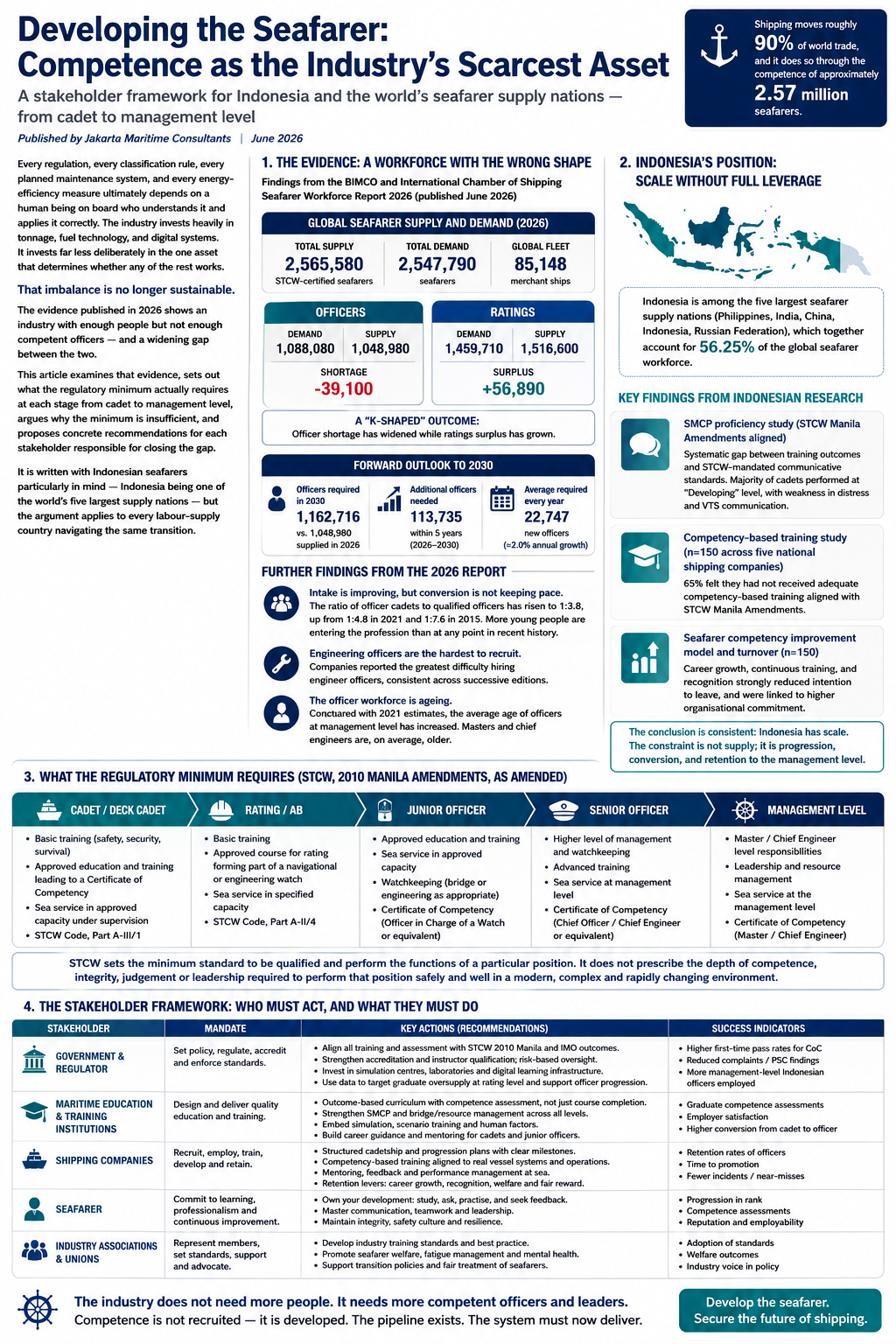
The global supply of STCW-certified seafarers now stands at approximately 2,565,580, operating 85,148 merchant ships. Against that, global demand is approximately 2,547,790. On the headline numbers, supply and demand are roughly in balance. That balance is an illusion.
Disaggregated, the picture inverts. The industry requires 1,088,080 officers but has only 1,048,980 — a shortage of 39,100 certified officers. Simultaneously it requires 1,459,710 ratings and has 1,516,600 — a surplus of 56,890. BIMCO and ICS describe this as a “K-shaped” outcome: the officer shortage has widened while the ratings surplus has grown.
The forward projection sharpens the point. By 2030 the world fleet will require 1,162,716 officers, meaning the industry must recruit and train an additional 113,735 certified officers within five years — an average of 22,747 new officers every year, or roughly 2.0% annual growth in the officer workforce. Since the 2021 report, demand for STCW-certified seafarers has risen 35% overall, with officer demand up 23.1% and ratings demand up 46.3%.
The industry does not have a recruitment problem. It has a progression problem. There are people. What is scarce is competence at the officer and management level — and competence is not recruited, it is developed.
Three further findings from the 2026 report deserve emphasis, because together they identify precisely where the pipeline is failing:
• Intake is improving, but conversion is not keeping pace. The ratio of officer cadets to qualified officers has risen to 1:3.8, up from 1:4.8 in 2021 and 1:7.6 in 2015. More young people are entering the profession than at any point in recent history. The shortage persists nonetheless — which means the loss is occurring after entry, in training, progression, and retention.
• Engineering officers are the hardest to recruit. Companies reported the greatest difficulty hiring engineer officers, a finding consistent across successive editions of the report. The technical management level is the narrowest point in the pipeline.
• The officer workforce is ageing. Compared with 2021 estimates, the average age of officers serving at management level has increased. Masters and chief engineers are, on average, older — which means a substantial cohort of accumulated experience is approaching retirement with insufficient successors behind it.
2. Indonesia’s position: scale without full leverage
Indonesia sits among the five largest seafarer supply nations, alongside the Philippines, India, China and the Russian Federation — a group that collectively accounts for 56.25% of the global seafarer workforce. For an archipelagic state of more than 17,000 islands with a deep maritime tradition, this is a natural position. It is also an underexploited one.
The distinction that matters is between supply and position in the value chain. Supplying large numbers of ratings generates employment and remittances. Supplying management-level officers generates substantially higher earnings per seafarer, greater career longevity, and — critically — a route into shore-based technical management, superintendency, and consultancy. Given a global surplus of ratings and a shortage of officers, the strategic question for Indonesia is not how many seafarers it can supply, but how many it can develop to the management level.
The peer-reviewed literature on Indonesian maritime education and training identifies where the friction lies, and the findings are consistent rather than isolated. A competency-based assessment of Standard Marine Communication Phrases (SMCP) proficiency among deck officers and cadets at Indonesian maritime institutions, aligned to the STCW Manila Amendments, found a systematic gap between institutional training outcomes and STCW-mandated communicative standards — with the majority of cadets performing at a “Developing” level and pronounced weakness in distress and VTS communication. Communication is not a peripheral skill; it is the medium through which every other competence is exercised on a multinational bridge.
A separate Indonesian study of 150 seafarers across five national shipping companies reported that 65% felt they had not received adequate competency-based training, and 48% indicated an intention to leave their position in the near term — with a simulation-based competency model raising average competency scores from 68% to 85% over six months. The sample is modest and the journal national rather than international, so the figures should be read as indicative rather than definitive. But the direction is consistent with the wider evidence: perceived training inadequacy and turnover intention travel together.
Research on traditional and non-conventional shipping in South Sulawesi similarly identifies certification and competency gaps concentrated at the senior technical ranks — chief engineer and motorman positions — with reduced capability in maintaining and installing engine components linked directly to increased ship downtime. This is the same bottleneck the global data identifies, observed locally.
The infrastructure exists: a substantial network of higher and vocational maritime institutions and approved training centres operates under the Indonesian Ministry of Transportation, delivering programmes leading to Certificates of Competency. The constraint is not the number of institutions. It is the alignment between what those institutions produce and what the international market requires at the operational and management levels — and the quality of the onboard phase that follows.
3. The regulatory minimum: the STCW ladder from cadet to management
The International Convention on Standards of Training, Certification and Watchkeeping for Seafarers (STCW), 1978, as amended, establishes the global minimum. Its architecture is worth understanding precisely, because much of the industry’s confusion stems from mistaking that minimum for a standard of professional adequacy.
The 1978 Convention entered into force in 1984 and was comprehensively revised in 1995, introducing the STCW Code — Part A mandatory, Part B recommended guidance — and, decisively, a competence-based approach assessed against observable criteria. The academic literature notes that the original 1978 instrument carried a bias toward a cognitive education paradigm whose outcomes were vague and did not optimally address on-the-job competence requirements; the 1995 amendments were the corrective. The 2010 Manila Amendments then modernised the framework further, adding leadership and teamwork at operational level, leadership and managerial skills at management level, ECDIS, revised rest-hour provisions, and measures against fraudulent certification.
The Convention structures the profession into three levels of responsibility, and progression through them is the central developmental question:
3.1 Support level — ratings
Every seafarer, regardless of rank, must hold Basic Safety Training under STCW Table A-VI/1: personal survival techniques, fire prevention and firefighting, elementary first aid, and personal safety and social responsibility. Ratings forming part of a navigational or engineering watch require certification under Regulations II/4 and III/4 respectively, involving approved seagoing service, training, and demonstrated competence. Able Seafarer Deck and Able Seafarer Engine (II/5, III/5) sit above this, requiring additional seagoing service.
From 1 January 2026, amendments to Table A-VI/1-4 adopted by resolution MSC.560(108) extend basic training to include competence relating to violence and harassment, including sexual harassment, bullying and sexual assault. The IMO Secretary-General has emphasised that the Convention does not distinguish between “existing” and “new” seafarers — the requirement applies to all.
3.2 Cadet — the officer trainee
The cadet stage is where the profession is genuinely made, and where it most often fails. STCW divides officer preparation into a shore-based academic phase at a maritime education and training institution and a mandatory onboard apprenticeship phase, documented through an approved Training Record Book. Officer of the Watch candidates require, in broad terms, not less than twelve months of approved seagoing service incorporating structured onboard training, or thirty-six months of seagoing service where the structured programme is not followed.
The intent of mandatory onboard training was that trainees would develop the substantive part of their competence through workplace learning — through legitimate participation in real work performed on board. The research literature is explicit that this intent is conditional. Its effectiveness depends on three things: the opportunity for trainees to participate in authentic work rather than observe it, proper mentorship from more experienced seniors, and a supportive onboard community of practice among the crew. Where any of the three is absent, the Training Record Book may be completed while the competence it certifies is not.
This is compounded by a structural scarcity the literature has documented repeatedly: the limited availability of training berths, together with variable training quality. A cadet cannot learn what a ship will not let them do.
3.3 Operational level — Officer of the Watch
Certification as OOW (Deck) under Regulation II/1 or OOW (Engine) under Regulation III/1 marks entry to the officer corps: the seafarer now holds independent watchkeeping responsibility. Requirements include the approved seagoing service and training described above, minimum age (18), medical fitness, completion of mandatory ancillary training — ECDIS, radar/ARPA, bridge or engine-room resource management, GMDSS for deck officers — and demonstrated competence against the standards in STCW Code Tables A-II/1 or A-III/1, including leadership and teamwork.
3.4 Management level — Chief Mate, Master, Second and Chief Engineer
Management-level certification under Regulations II/2 (Chief Mate and Master) and III/2 (Second Engineer and Chief Engineer) requires approved seagoing service at the operational level — typically not less than twelve months for Chief Mate or Second Engineer, and thirty-six months for Master or Chief Engineer, with reductions permitted in defined circumstances — together with approved education and training and demonstrated competence against Tables A-II/2 or A-III/2. This level adds leadership and managerial skills, and the accountability that accompanies them.
All certificates require revalidation at intervals not exceeding five years, generally through evidence of continued professional competence including approved seagoing service of at least twelve months within the preceding five years.
3.5 The superintendent — and the regulatory silence
Here the framework stops. There is no STCW certificate for a technical superintendent, a fleet manager, a marine superintendent, or a shore-based DPA. The role that sets maintenance budgets, approves docking specifications, selects yards, allocates resources, and shapes safety culture across an entire fleet has no international competence standard governing entry to it.
The ISM Code does address company responsibility — it requires the company to ensure adequate resources and shore-based support, to define responsibilities clearly, and to establish that personnel are qualified for their tasks. But it prescribes no syllabus, no examination, and no certificate. Notably, BIMCO has cautioned in the current STCW review that a clear distinction must be maintained between training requirements under STCW and company responsibilities under the ISM Code — a boundary that is correct in law but which leaves a genuine developmental gap in practice.
The consequence is visible across the industry. A newly promoted superintendent typically arrives from the sea with deep technical knowledge of one ship type and no formal preparation for budget management, contract negotiation, yard supervision, data-driven fleet oversight, or the management of people they cannot see. The transition from managing a machine to managing a system is the least supported step in the entire maritime career, and it is the step with the widest organisational consequences.
4. Summary: the competence ladder at a glance
The table below summarises the progression and, in the final column, the developmental requirement that regulation does not address.
|
Stage |
Principal STCW basis |
Core minimum requirement |
What regulation does not provide |
|
Rating / support |
A-VI/1; II/4, III/4; II/5, III/5 |
Basic Safety Training; approved seagoing service; demonstrated competence |
Career pathway into cadetship; literacy and English foundation |
|
Cadet |
II/1, III/1 (training phase) |
Approved MET programme; ≈12 months structured onboard training with Training Record Book |
A training berth; authentic work; an assigned mentor; a supportive crew |
|
Operational — OOW |
II/1, III/1; A-II/1, A-III/1 |
Seagoing service; age 18; medical fitness; ECDIS, ARPA, BRM/ERM, GMDSS; leadership and teamwork |
Judgement under pressure; consolidation of watchkeeping experience |
|
Management — Chief Mate / 2E |
II/2, III/2; A-II/2, A-III/2 |
≈12 months approved service at operational level; approved training; leadership and managerial skills |
Coaching capability; commercial awareness; planned succession |
|
Management — Master / CE |
II/2, III/2 |
≈36 months approved service (reducible); full management-level competence |
Mentoring skill; ability to build onboard learning culture |
|
Superintendent / shore manager |
None — ISM Code company duty only |
No international competence standard exists |
Structured transition: budgets, contracts, data, fleet oversight, people management |
5. Why the minimum is not enough
STCW is a floor, not a ceiling. It defines the point below which a seafarer may not lawfully serve. It does not define the point at which a seafarer is genuinely good at the job — and the industry’s persistent conflation of the two is the root of much of its human-element difficulty.
The gap is widening for reasons that are structural rather than cultural. The competence profile the industry needs is changing faster than the instrument that certifies it. Research published in the WMU Journal of Maritime Affairs on the skills required for smart shipping operations categorises future competencies across technical, cognitive, individual, and social domains — a framework substantially broader than the task-based competence tables of the STCW Code. Parallel work on integrating twenty-first century skills into STCW competences reaches similar conclusions, as does research on the competencies required of future operators of highly automated vessels, where maritime stakeholders converge strongly on the view that ICT, information management, troubleshooting, and communication skills are essential — and that a seafaring background remains foundational.
Meanwhile the operational reality has shifted underneath the certificate. An officer today must manage emissions data with financial consequences under the EU ETS, understand carbon intensity ratings, operate ECDIS-based navigation, work within a cyber-resilient system architecture, prepare for alternative fuels, and function in a multinational crew where communication failure is a primary accident pathway. Simulator-based research on full-mission bridge training reinforces the point that simulation develops not only navigational proficiency but the specialised communicative practices — leadership, decision-making, disciplinary literacy — that officers must acquire to fulfil their responsibilities.
None of this is captured by counting sea time. Competence is developed through structured exposure, deliberate mentorship, and reflective practice — not accumulated automatically by presence on board.
6. The STCW comprehensive review: a narrow window to influence the framework
This matters urgently because the framework is, at this moment, being rewritten — and the outcome will govern seafarer development for a generation.
In 2024 the IMO initiated a comprehensive review of the STCW Convention and Code, following agreement at the Maritime Safety Committee. Its scope is unprecedented. The eleventh session of the Sub-Committee on Human Element, Training and Watchkeeping (HTW 11, February 2025) completed the gap-identification phase and identified more than 400 gaps in the existing instrument. The twelfth session (HTW 12, 23–27 February 2026) considered 168 submitted documents and began substantive drafting, concentrating on strategic direction given the volume of input. An Intersessional Working Group met in March 2026, with work continuing toward HTW 13 in 2027.
The review is addressing, among much else: updated competence requirements for deck and engine departments; training for alternative fuels, with interim guidelines approved for methyl and ethyl alcohols and ammonia and further work underway on hydrogen, LPG, fuel cells, battery power and wind propulsion; violence and harassment; mental health and psychological safety; gender and cultural diversity; certification fraud and the digitalisation of certificates; strengthening the “White List” and its integration with the IMO Member State Audit Scheme; and a newly launched, evidence-based scoping exercise on fatigue and hours of work and rest spanning both STCW and the Maritime Labour Convention, targeted for completion in 2027.
Two implications follow for supply nations such as Indonesia. First, the competence standards that will define market access for the next generation of Indonesian officers are being drafted now — participation in the process, through the administration and through industry bodies, is more valuable than adaptation after the fact. Second, BIMCO has warned that the cumulative impact of amendments on training duration, cost, and career pathways requires careful attention. Longer and more expensive training pathways fall hardest on cadets from developing supply nations. Institutions and administrations that prepare early will protect their seafarers’ access to the global market; those that wait will find the bar raised before they have adjusted.
7. Whose responsibility? A stakeholder framework
The IMO itself frames the human element as a shared responsibility — of the Organization as regulator, Member States as implementers, companies as providers of resources, safety policy and safety culture, and seafarers as those who physically operate ships. The framework below extends that logic to the parties who actually determine whether an individual seafarer develops.
7.1 Ship owners and ship management companies
Owners hold the decisive lever, because they control training berths, budgets, and career structure. The uncomfortable truth is that officer competence is a commons: every owner benefits from a deep pool of competent officers, but each individual owner is tempted to hire ready-made officers trained by someone else. When enough owners reason this way, the pool empties — which is precisely what the 39,100-officer shortage represents. An owner who does not train cadets is not saving money; they are deferring a cost onto a market that is already short.
Owners also control the two variables that most affect retention: whether a seafarer sees a credible path from cadet to master or chief engineer, and whether the ship is a place where learning is possible. Both are budget decisions before they are cultural ones.
7.2 Education and training institutions
METIs convert intake into capability. The evidence — particularly the Indonesian SMCP findings — suggests that the binding constraint is not curriculum coverage but the gap between classroom delivery and demonstrated operational competence. Certificates that do not correspond to capability damage the reputation of an entire national supply, and reputation is the asset on which market access depends.
Institutions also carry a responsibility that regulation does not impose: preparing cadets for the reality of the onboard phase — how to learn from a busy chief engineer, how to ask for work, how to keep a Training Record Book that reflects genuine competence rather than signatures collected.
7.3 The seafarers themselves
Seafarers are not passive recipients of development, and any framework that treats them as such will fail. The certificate is the employer’s minimum requirement; the career belongs to the individual. In a market with a rating surplus and an officer shortage, the returns to deliberate self-development — English proficiency, engineering specialisation, digital and data literacy, willingness to take the harder ship and the harder trade — have rarely been higher. The seafarer who treats revalidation as the extent of their professional development is competing for the crowded part of the market.
7.4 Senior officers and superintendents
This is the group whose influence most exceeds its formal mandate. Masters, chief engineers, and superintendents determine, in daily practice, whether the onboard phase produces competence or merely sea time. The research on shipboard learning is unambiguous: development depends on authentic participation, mentorship from experienced seniors, and a supportive community of practice. Every one of those three is delivered — or withheld — by senior officers.
Yet mentoring is not a competence anyone certified them in. A chief engineer is examined on machinery, not on how to develop a fourth engineer. Studies of maritime mentoring programmes point to their value in the professional integration of seafarers, while noting that sustainability of such programmes remains the practical challenge. Mentoring capability should be treated as a management-level competence to be taught, resourced, and recognised — not as a personal virtue some seniors happen to possess.
For superintendents the responsibility is doubled: they mentor the fleet’s seniors while themselves occupying the one role with no competence standard at all.
7.5 Flag States and maritime administrations
Administrations own the integrity of the certificate. In Indonesia’s case, the Ministry of Transportation approves institutions and issues Certificates of Competency — and therefore underwrites the credibility of every Indonesian seafarer in the global market. The IMO’s current work on certification fraud, the STCW GISIS reporting module, digital certificate verification, and the strengthening of the White List through integration with the Member State Audit Scheme all converge on a single point: certificate integrity is becoming measurable and comparable across flags. Supply nations whose certificates are trusted will command the officer market; those whose are not will be confined to the surplus end of it.
7.6 Manning agencies and crewing managers
Agencies sit between supply and demand and shape the incentive structure both feel. Where an agency competes purely on cost and speed of placement, it transmits a signal that competence is not priced. Where it competes on the demonstrated quality and progression of its pool, it becomes a development institution in its own right. The choice determines whether an agency is a bottleneck or a multiplier.
7.7 Charterers, financiers, and insurers
These parties rarely see themselves as stakeholders in seafarer development, but they are among the most powerful. Vetting regimes, charterparty requirements, insurance terms, and financing conditions all encode assumptions about crew quality. When these actors examine crew competence, retention, and training investment as indicators of management quality — as they increasingly examine safety and environmental performance — the commercial case for development strengthens across the market.
8. Recommendations
The following are offered as practical priorities rather than aspirations. Each is directed at the party with the authority to act on it.
To ship owners and managers
1. Treat cadet berths as fleet infrastructure, not welfare. Set an explicit cadet-per-vessel ratio, budget it, and audit it. The industry needs 22,747 new officers annually to 2030; that number is the sum of individual owners’ decisions.
2. Fund mentorship explicitly. Allocate paid time for senior officers to train juniors, and assess them on it. Unfunded mentorship is a request for volunteers, and it is the first thing sacrificed under commercial pressure.
3. Build and publish a career map. Show cadets the route to master or chief engineer with the milestones and timeframes. Retention research consistently links perceived career path to intention to stay.
4. Prioritise the engineering pipeline. Engineer officers are the reported hardest-to-fill category and the narrowest point in the pipeline. Target development investment where the scarcity is greatest.
5. Prepare now for alternative-fuel and digital competence. Interim IMO training guidelines already exist for methanol and ammonia. Owners ordering dual-fuel tonnage without a parallel crew-competence plan are ordering a manning problem.
6. Structure the sea-to-shore transition. Design a formal preparation pathway into superintendency covering budgets, contracts, yard supervision, data, and people management. Regulation will not do this; only the company can.
To education and training institutions
7. Assess against operational competence, not syllabus completion. Where documented gaps exist — SMCP and distress communication being clearly evidenced in Indonesia — measure, publish, and close them.
8. Invest in simulation as a competence platform. Full-mission simulation develops leadership, decision-making, and communicative practice alongside technical proficiency, and partially compensates for training-berth scarcity.
9. Build formal partnerships with owners and managers. Onboard training quality is not within an institution’s control — but the relationships that secure good berths are.
10. Prepare cadets to learn at sea. Teach how to seek authentic work, use a Training Record Book honestly, and engage seniors. This is a teachable skill and it determines the value of the entire onboard phase.
11. Track the STCW review and adapt early. The gaps identified and the drafting now underway will define the competence tables of the next decade.
To seafarers
12. Treat the certificate as the starting line. It is the minimum an employer may accept, not a measure of professional standing.
13. Invest in English and communication deliberately. The documented proficiency gap in maritime communication is a direct, addressable constraint on progression — and it compounds across every other competence.
14. Build digital and data literacy. Emissions reporting, PMS discipline, condition monitoring, and cyber awareness are becoming operational competencies rather than specialisms.
15. Seek authentic work and real mentors. Learning at sea depends on participation. Ask for the job; find the senior who teaches.
16. Plan the management-level transition early. Management-level service requirements are known years in advance. The officers who reach the top plan for it from the operational level.
To senior officers and superintendents
17. Accept mentoring as part of the rank. The competence of the next generation is transmitted by those who hold the current one. No instrument will certify this; the profession depends on it regardless.
18. Give cadets real work, supervised. Observation does not build competence. Participation does.
19. Model the safety and learning culture. Seniors set what is normal on board — including whether questions are welcome and mistakes are surfaced.
20. Superintendents: invest in your own development. The role has no competence standard, which makes deliberate self-development a professional obligation rather than an option.
To administrations, agencies, and commercial stakeholders
21. Administrations: protect certificate integrity above all. Support digital verification and audit-scheme integration; the market is becoming able to distinguish trustworthy flags from the rest.
22. Administrations: engage the STCW review actively. Supply nations that shape the standard protect their seafarers’ market access; those that receive it must adapt to terms set by others.
23. Manning agencies: compete on quality and progression, not placement speed alone. Price competence, and the market will supply it.
24. Charterers, financiers and insurers: examine crew development as a management-quality indicator. What these parties measure, the market delivers.
9. Conclusion
The 2026 workforce data delivers a message that is easy to misread. It does not say that shipping is running out of people; the ratings surplus is proof of that. It says that shipping is failing to convert people into competent officers fast enough to operate the fleet it is building — while simultaneously raising the competence bar through decarbonisation, digitalisation, and a comprehensive rewriting of the STCW framework.
For Indonesia, this is a strategic opening rather than a threat. The country already supplies the people. The question is whether it develops them — and whether owners, institutions, administrations, senior officers, and seafarers themselves each accept the part of that task that only they can perform. A rating surplus and an officer shortage in the same market is not an accident of demography. It is a description of a development pipeline that leaks at every stage where responsibility is assumed to belong to someone else.
Competence is the industry’s scarcest asset. Unlike tonnage, it cannot be ordered from a yard, and unlike fuel, it cannot be bought at short notice. It can only be developed — deliberately, expensively, and by everyone at once.
How Jakarta Maritime Consultants can help
Seafarer development is not separate from asset management — it is the mechanism through which asset management actually happens. A planned maintenance system produces reliability only if crews are trained to use it; a docking specification is executed well only if the superintendent supervising it knows what to look for; emissions data is defensible only if the people generating it understand why it matters.
Our practice works at that intersection. We deliver PMS training that builds genuine maintenance and data competence rather than software familiarity, and we provide mentorship for ship and shore teams — including the sea-to-shore transition into superintendency that no certificate prepares anyone for. Through our fleet management consultancy we help owners structure the technical capability of their organisations so that competence is developed by design rather than left to chance.
If you would like to discuss a competence development programme for your fleet, or structured mentorship for your shore-based technical team, contact our team.
References — Peer-reviewed literature
Emad, G.R. et al. (2023). Theorizing seafarers’ participation and learning in an evolving maritime workplace: an activity theory perspective. WMU Journal of Maritime Affairs, 22. https://doi.org/10.1007/s13437-023-00311-8 (Scopus-indexed)
Special issue on key concepts in maritime education and training (2025). WMU Journal of Maritime Affairs. https://doi.org/10.1007/s13437-025-00385-6 (includes Karatug on competencies for smart shipping; Amundsen & Noble on full-mission bridge simulation) (Scopus-indexed)
Integrating twenty-first century skills into STCW competences: implications for maritime education and training (2025). WMU Journal of Maritime Affairs. https://doi.org/10.1007/s13437-025-00368-7 (Scopus-indexed)
Identifying essential skills and competencies towards building a training framework for future operators of autonomous ships: a qualitative study (2023). WMU Journal of Maritime Affairs. https://doi.org/10.1007/s13437-023-00310-9 (Scopus-indexed)
Vocational and academic approaches to maritime education and training (MET): Trends, challenges and opportunities (2017). WMU Journal of Maritime Affairs. https://doi.org/10.1007/s13437-017-0130-3 (Scopus-indexed)
Adapting to change: International maritime education and training for future seafarers — focusing on the comprehensive review of the STCW Convention and Code at IMO HTW 10 (2025). Journal of International Maritime Safety, Environmental Affairs and Shipping. https://doi.org/10.1080/25725084.2025.2464486
Improving onboard training for deck cadets: an analysis through the lens of learning theories. World Maritime University PhD Dissertations. https://commons.wmu.se/phd_dissertations/43/
World Maritime University (2023). Transport 2040: Impact of Technology on Seafarers — The Future of Work. https://doi.org/10.21677/230613
References — Indonesia-focused studies
Standardized Marine Communication Proficiency Among Indonesian Maritime Institutions: a competency-based assessment aligned with the STCW Manila Amendments. International Journal of Marine Engineering Innovation and Research (ITS). Mixed-methods study, n=120.
Competency and Certification Gaps Among Traditional Shipping Seafarers in South Sulawesi, Indonesia (2025). MDPI. https://www.mdpi.com/2673-7590/5/4/139
Marsudi, S. et al. Seafarer competency improvement model and turnover in the Indonesian maritime industry. International Journal of Marine Engineering and Applications (Hang Tuah University). Mixed-methods study, n=150 across five national shipping companies. [National journal — indicative rather than definitive.]
Junus, A.D.P. Employment of Indonesian Seafarers: Challenges and Opportunities. [Reports the network of maritime higher and vocational institutions registered with the Indonesian Ministry of Transportation.]
References — Regulatory and industry sources
BIMCO and International Chamber of Shipping (2026). Seafarer Workforce Report 2026 — Executive Summary. Published June 2026. www.bimco.org
International Maritime Organization. International Convention on Standards of Training, Certification and Watchkeeping for Seafarers (STCW), 1978, as amended (1995 amendments and STCW Code; 2010 Manila Amendments). www.imo.org
International Maritime Organization. Comprehensive Review of the STCW Convention and Code — FAQs; HTW 11 (February 2025) gap analysis; HTW 12 (23–27 February 2026) outcomes; ISWG-STCW 2 (March 2026). www.imo.org
International Maritime Organization. Resolution MSC.560(108) — amendments to STCW Code Table A-VI/1-4 on violence and harassment, applicable from 1 January 2026.
International Maritime Organization. ISM Code (SOLAS Chapter IX) — company responsibilities, resources and personnel.
BIMCO (2026). HTW 12: IMO advances seafarer training and launches new fatigue management initiative. www.bimco.org
IFSMA (2026). Revision of STCW and Fatigue — report on HTW 12. www.ifsma.org
Liberian Registry (LISCR) (2026). IMO HTW 12 Meeting Summary. www.liscr.com
Regulatory positions are stated as of mid-2026. The comprehensive review of the STCW Convention and Code is ongoing, with drafting continuing toward HTW 13 in 2027; no amendments arising from the review have yet been adopted, and the descriptions above reflect matters under consideration rather than settled requirements. STCW service and training requirements are summarised in general terms and are subject to conditions, equivalences and reductions set out in the Convention and Code and in national implementing legislation; seafarers and companies must confirm exact requirements with the relevant maritime administration. Workforce figures are estimates published by BIMCO and ICS based on their stated methodology, and the 2021 and 2026 estimates are not directly comparable with editions before 2015 owing to methodological change.