The Urgency of Digital Transformation in Ship Management
Why digitalisation has moved from competitive advantage to operational necessity
Published by Jakarta Maritime Consultants
For most of the last decade, digitalisation in ship management was discussed as an opportunity — something forward-looking owners might pursue for competitive advantage, and something the rest could defer until the technology matured and the business case became clearer. That framing is now out of date.
Three developments have quietly changed the terms of the debate. Regulation has become digital by design, so that compliance itself now depends on data infrastructure. Cyber resilience has moved from voluntary guidance to a classification requirement. And carbon has acquired a price, making the accuracy of operational data a direct financial variable. Digitalisation is no longer a strategic option that owners may take or leave; it has become the operating environment in which ship management is conducted.
This article examines the evidence for that shift — drawing on peer-reviewed literature and current regulatory instruments — and sets out what it means in practice for owners and managers who must act on it.
1. Where the industry actually stands
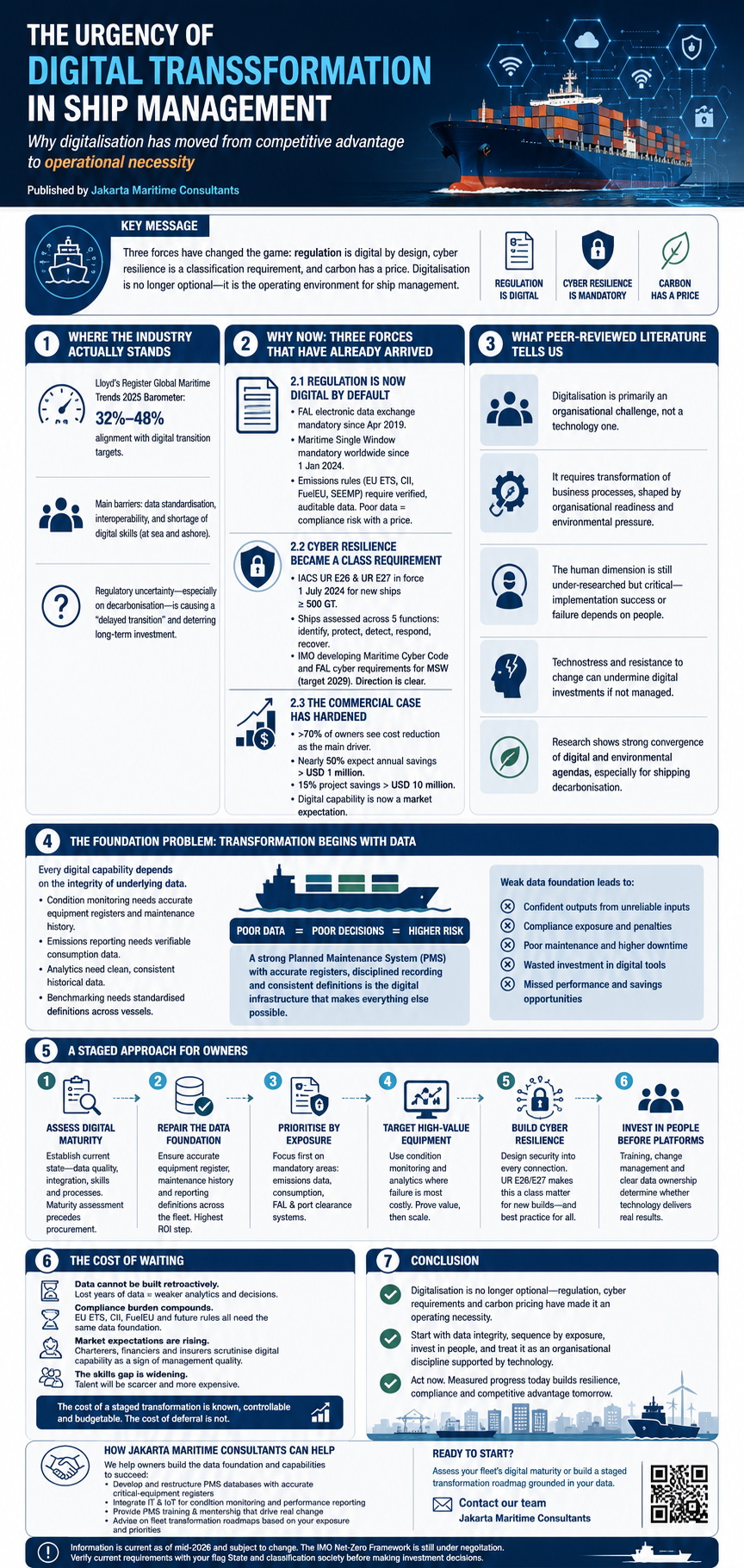
The maritime sector’s digital lag is well documented and, importantly, now quantified. The inaugural Global Maritime Trends 2025 Barometer, published by Lloyd’s Register and the Lloyd’s Register Foundation, assessed the industry’s digital transition across trade, energy, vessels, ports, and people. It found the sector scoring between 32% and 48% alignment with its digital transition targets — progress, but still meaningfully behind land-based industries.
The Barometer’s diagnosis of the causes is worth quoting in substance, because it names the same three barriers that recur throughout the academic literature: data standardisation, interoperability, and a widespread shortage of digital skills among both seafarers and shore-based teams. Notably, none of these is a hardware problem. The constraint is not the availability of technology; it is the organisational and human capacity to use it.
The Barometer also identifies a second-order effect that owners will recognise. Regulatory uncertainty — particularly around decarbonisation — is deterring long-term investment, producing what Lloyd’s Register terms a “delayed transition.” Owners hesitate because the rules are moving; but the rules that are already fixed increasingly require digital capability regardless.
2. Why now: three forces that have already arrived
The case for urgency does not rest on forecasts. It rests on instruments already in force.
2.1 Regulation is now digital by default. Under the IMO’s Convention on Facilitation of International Maritime Traffic (FAL), electronic data exchange between ships and ports has been mandatory since April 2019. The 2022 amendments adopted by resolution FAL.14(46) went further: since 1 January 2024, Maritime Single Windows — single digital portals through which all ship clearance information is exchanged — have been mandatory in ports worldwide. All references to paper-based forms have been removed from the Convention. Ship clearance, in other words, is now a data transaction by law.
The same logic extends to environmental compliance. The EU Emissions Trading System, the Carbon Intensity Indicator, and FuelEU Maritime all depend on verified, auditable emissions and consumption data. The IMO’s 2024 SEEMP guidelines (resolution MEPC.395(82)) formally recognise condition monitoring and performance management as energy-efficiency tools. An owner cannot demonstrate compliance with any of these instruments without a data system capable of producing defensible figures. Poor data is no longer merely inefficient — it is a compliance exposure with a price attached.
2.2 Cyber resilience became a class requirement. On 1 July 2024, the International Association of Classification Societies’ Unified Requirements UR E26 (“Cyber Resilience of Ships”) and UR E27 (“Cyber Resilience of On-Board Systems and Equipment”) entered into force for new ships contracted for construction on or after that date, applying to vessels of 500 GT and above. UR E26 treats the ship as a collective entity across five functional aspects — identification, protection, detection, response, and recovery — while UR E27 sets minimum security capabilities for computer-based systems supplied by third parties.
The significance is structural rather than technical. Cyber resilience has crossed from voluntary guidance into a minimum condition of classification. The IMO’s Facilitation Committee has since begun developing a non-mandatory Maritime Cyber Code, and has approved draft FAL amendments requiring cybersecurity measures for Maritime Single Windows, expected to enter into force in 2029. The direction of travel is unambiguous: as ships become more connected, the regulatory perimeter expands with them. Digitalisation and cyber risk are not separate agendas — they are the same agenda.
2.3 The commercial case has hardened. Industry research indicates that owners themselves now see digitalisation primarily as a cost instrument rather than an experiment. Thetius’ study Riding the Digital Wave (2024) reports that more than 70% of shipowners and managers identify cost reduction as the principal driver for digitalisation, with nearly half anticipating annual savings above USD 1 million and 15% projecting savings exceeding USD 10 million. Whatever margin of optimism these projections carry, the expectation itself is now embedded in how the market values digital capability — and increasingly in what charterers and financiers expect to see.
3. What the peer-reviewed literature tells us
The scholarly evidence base has matured considerably, and it delivers a consistent and somewhat uncomfortable message: the obstacles to maritime digitalisation are predominantly organisational, not technological.
A systematic literature review published in the Journal of Marine Science and Engineering (2025) applied the Technology–Organisation–Environment framework to digitalisation in maritime logistics, synthesising the enablers and barriers reported across the peer-reviewed literature. Its central finding is that digitalisation is not a discrete technology purchase but a transformation of business processes — and that the diffusion of these technologies is shaped as much by organisational readiness and environmental pressure as by the technologies themselves.
Complementing this, a systematic review in the Journal of Shipping and Trade (2024) examined maritime human resource management in the digital transition and found the research base on the human dimension notably thin relative to the technical literature — despite the human factor being where implementation most often succeeds or fails. Related work on technostress and resistance to change in maritime digital transformation reaches a parallel conclusion: the integration of automation, data analytics, and interconnected systems affects not only workflows but the people operating them, and ignoring that dimension undermines the investment.
Meanwhile, a bibliometric analysis published in Frontiers in Marine Science (2025), examining 201 publications indexed in SCI-EXPANDED and SSCI from 2005 to 2024, documents the rapid expansion of research into digital technologies for shipping decarbonisation — confirming that the convergence of the digital and environmental agendas is now a settled feature of the field rather than a speculative link.
The consistent finding across this literature is that digital transformation in shipping is a socio-technical problem. Technology is the easy part; data discipline, process design, and human capability are where value is won or lost.
4. The foundation problem: transformation begins with data
This body of evidence carries a practical implication that owners should take seriously, because it runs counter to how digitalisation is usually sold. The instinct is to begin with the visible layer — a platform, a dashboard, a sensor package. The literature and the operational experience both suggest the opposite sequence.
Every downstream capability depends on the integrity of the underlying data. Condition-based maintenance requires an accurate equipment register and a properly structured maintenance history. Emissions reporting requires consumption data that reconciles with verified returns. Predictive analytics require enough clean, consistent historical data to train on. Fleet performance benchmarking requires standardised definitions across vessels. Where the foundation is weak — incomplete equipment registers, generic maintenance jobs, inconsistent reporting between ship and shore — digital tools built on top of it produce confident outputs from unreliable inputs, which is a worse position than having no tool at all.
This is why the Planned Maintenance System database deserves to be understood as digital infrastructure rather than as compliance paperwork. It is, for most owners, the single largest structured dataset about the physical asset. A PMS built around an accurate critical-equipment register, disciplined recording, and consistent definitions is the platform on which condition monitoring, analytics, and performance management can actually be constructed. One that has drifted out of step with the ship is a liability that digitalisation will amplify rather than fix.
5. A staged approach for owners
The evidence supports a deliberate, sequenced strategy rather than either wholesale transformation or continued deferral:
1. Assess digital maturity honestly. Establish where the organisation actually stands — data quality, system integration, skills, and process discipline — before selecting technology. Maturity assessment precedes procurement.
2. Repair the data foundation. Ensure the equipment register, maintenance history, and reporting definitions are accurate and consistent across the fleet. This is unglamorous work with the highest return on investment of any step.
3. Prioritise by regulatory and commercial exposure. Emissions and consumption data, and the systems supporting FAL and port clearance, are already mandatory. These are not discretionary and should be addressed first.
4. Target high-value equipment for condition monitoring. Apply sensors and analytics where failure is most costly, prove the value, then extend. A staged rollout produces evidence; a fleet-wide rollout produces risk.
5. Build cyber resilience into the design. Every new connection expands the attack surface. Under UR E26/E27 this is now a class matter for new tonnage, and prudent practice for existing ships.
6. Invest in people before platforms. The literature is emphatic on this point. Training, change management, and clear ownership of data determine whether the technology delivers. Systems do not transform organisations; capable people using them do.
6. The cost of waiting
The temptation to wait is understandable. Regulatory uncertainty is real — the IMO Net-Zero Framework remains under negotiation — and capital is scarce in a low-margin industry. But waiting carries its own accumulating cost, and it is easy to underestimate.
Data infrastructure cannot be assembled retrospectively. Predictive models require years of clean historical data; an owner who begins collecting it in 2028 cannot recover the intervening period. Meanwhile, the compliance burden compounds: full EU ETS coverage, tightening CII thresholds, FuelEU, and the framework still to come all draw on the same data foundation. Charterers, financiers, and insurers are increasingly examining digital and data capability as an indicator of management quality. And as Lloyd’s Register’s Barometer notes, the digital skills gap is itself widening — the organisations that begin building capability now will find it easier than those that start later, competing for scarcer talent.
The asymmetry is the point. The cost of a measured, staged transformation is known, budgetable, and controllable. The cost of deferral is neither.
7. Conclusion
The question facing ship owners is no longer whether to digitalise. Regulation has already decided that: ship clearance is electronic by law, emissions compliance is a data exercise, and cyber resilience is a class requirement. The remaining questions are how quickly, in what order, and on what foundation.
The evidence points to a clear answer. Begin with data integrity rather than technology. Sequence by regulatory and commercial exposure. Invest in people alongside systems. And treat the transformation as what the literature consistently shows it to be — an organisational discipline supported by technology, not a technology project with organisational side-effects.
How Jakarta Maritime Consultants can help
This transformation is precisely the ground our practice occupies. We work with owners and managers to build the data foundation on which digitalisation depends — developing and restructuring PMS databases around accurate critical-equipment registers, integrating IT and IoT solutions for condition monitoring and performance reporting, and delivering the PMS training and mentorship that turn new systems into working practice rather than shelfware. Our fleet management consultancy helps owners sequence the transition according to their own regulatory exposure and commercial priorities, so that investment follows evidence.
If you would like to assess your fleet’s digital maturity, or build a staged transformation roadmap grounded in your actual operating data, contact our team.
References — Peer-reviewed literature
Chen, X. et al. (2025). Digitalization in the Maritime Logistics Industry: A Systematic Literature Review of Enablers and Barriers. Journal of Marine Science and Engineering, 13(4), 797. https://doi.org/10.3390/jmse13040797 (Scopus-indexed)
Progoulaki, M. et al. (2024). Challenges of maritime human resource management for the transition to shipping digitalization. Journal of Shipping and Trade, 9. https://doi.org/10.1186/s41072-024-00165-0 (Scopus-indexed)
Application, opportunities, and challenges of digital technologies in the decarbonizing shipping industry: a bibliometric analysis (2025). Frontiers in Marine Science, 12. https://doi.org/10.3389/fmars.2025.1523267 (Scopus-indexed; analysis of 201 SCI-EXPANDED and SSCI publications, 2005–2024)
Digital twin adoption in port authorities: a structured framework for use case assessment (2026). Journal of Shipping and Trade. https://doi.org/10.1186/s41072-026-00234-6 (Scopus-indexed)
Technostress and Resistance to Change in Maritime Digital Transformation: A Focused Review (2024). arXiv:2408.17408 (preprint)
References — Regulatory and industry sources
International Maritime Organization. Convention on Facilitation of International Maritime Traffic (FAL); resolution FAL.14(46); Maritime Single Window mandatory from 1 January 2024. www.imo.org
International Maritime Organization. 2024 SEEMP Guidelines, resolution MEPC.395(82). www.imo.org
International Association of Classification Societies. UR E26 “Cyber Resilience of Ships” and UR E27 “Cyber Resilience of On-Board Systems and Equipment”, in force 1 July 2024. www.iacs.org.uk
Lloyd’s Register and Lloyd’s Register Foundation (2025). Global Maritime Trends 2025 Barometer. www.lr.org
Thetius (2024). Riding the Digital Wave. www.thetius.com
Regulatory positions are stated as of mid-2026 and remain subject to change; the IMO Net-Zero Framework in particular is still under negotiation. Industry survey figures reflect respondent expectations rather than audited outcomes. Owners should verify current requirements with their flag State and classification society before making investment decisions.